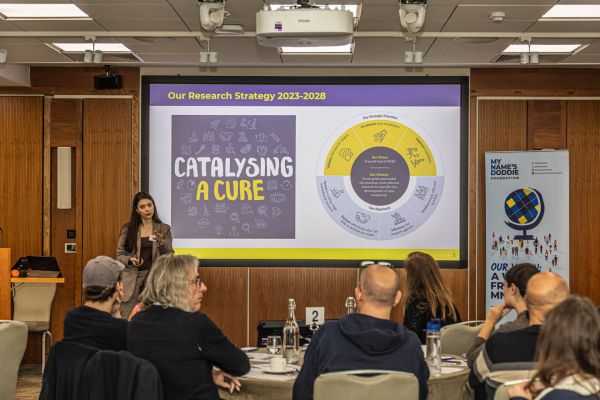
On 12 November, we welcomed around 60 delegates at No. 11 Cavendish Square, London, for our first Discovery Network Showcase. A month on, we reflect on the day and share our highlights.
We have previously talked about the Discovery Network; our largest single research programme to date, supported by an initial £4 million. It was created with the purpose of sparking collaboration and accelerating research to better understand MND and identify new therapeutic targets. Our first four teams - which include over 30 researchers from 11 universities across the UK, the US, and Singapore - have started their projects and the Network’s activities are in full swing. This means that we’ve been busy behind the scenes, building solid foundations for the Network so it can deliver on its goals.
The Showcase was the first time we brought together our Discovery Network researchers in one place, along with our Discovery Network Advisory Board, industry experts and, crucially, people living with - and affected by - MND. This in itself was one of our highlights: from formulating the idea of the Discovery Network to having the teams in place and holding our first in-person research event was almost two years in the making. Seeing everyone together in a room, exchanging, debating, building relationships and making plans, made it all much more real and impactful.
We aim to accelerate MND research and the search for effective treatments by improving the translation of findings from the lab towards the clinic. The Discovery Network sits at the very beginning of this journey, and we want to ensure our researchers know what their next steps will be, with input and support from industry. That is why the morning session was dedicated to drafting a Target Assessment Framework: a research tool for our researchers to robustly assess and progress their findings. It’s important that we look beyond MND and learn from other neurodegenerative conditions, and we are thankful to our delegates who shared approaches from the Psychiatry Consortium and the Michael J. Fox Foundation (for Parkinson’s) with us on the day, as well as all the industry experts who facilitated in-depth roundtable discussions.
In the afternoon, we held a “Shaping the Discovery Network” session, with everyone contributing to discussions on how we can encourage true collaboration, innovative thinking on research funding, support for early career researchers, and how to tackle some thorny challenges around IP and contracting delays with research institutions. Our four team leaders also presented their projects for the first time, with thought-provoking questions and feedback from the audience.
Our biggest highlight of the day was being able to award two Doddie Champion Caps, to two of our incredible Discovery Network Advisory Board members: Dr Jennie Starkey and Dr Luke Hames-Brown. Luke and Jennie, who both have MND, have been involved with the Network from day one, reviewing applications and providing invaluable insights.
During the event, we were thrilled to learn (from our friends at Scottish Rugby) that Doddie’s match ball delivery at Murrayfield in 2017 was voted the most memorable moment in the stadium’s 100-year history. The news resonated deeply with everyone in the room. Eight years on, we continue to build on Doddie’s legacy, with a community that is stronger and more determined than ever.