Cell therapy to restore muscle
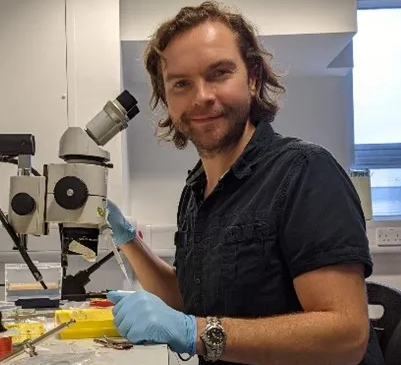
Dr Barney Bryson, Prof Linda Greensmith, University College London
Co-funded project
Accelerate new treatments
August 2022 - November 2025
£174,532.91*
Summary
In people living with MND, motor neurons no longer send messages to the muscles, causing weakness and muscle wasting. An innovative technology has been developed to create new connections between motor neurons and muscles using genetically engineered motor neurons, obtained from stem cells, that respond to pulses of light. It has been shown to enable muscle contraction using light signals.
Dr Bryson and Professor Greensmith are adapting this technology so that it can be used in animal models of disease to test the ability of human-compatible, replacement motor neurons to be activated by light, restore muscle contraction and prevent muscle wasting. If successful, this technology has the potential to restore function of paralysed muscles in people living with MND.
Why this research is important
This project could potentially lead to the development of a completely novel approach to treating MND. Having more options for therapeutics in MND means that people living with the disease are more likely to be offered at least one that has a real impact on their disease.
Results of the proof-of-principle study that led to this research were published in eLife in 2023.
To learn more about stem cells and MND research, check out our infographic.
*This project is part of the Motor Neuron Disease Translational Research Fund and is co-funded by LifeArc and MND Association. Total funding for this grant is £523,598.75.
More research projects
View all
Hear about future funding
By subscribing, you confirm that you agree with our terms and conditions.