Motor neuron disease is a complex condition with different underlying causes including genetics and it has different effects in different people. Over recent years, progress has been made in understanding some of the factors leading to the condition, including genes that may play a role. It is thought to be caused by interactions between environmental and genetic factors. This means that some individuals’ genetic make-up could put them at a higher risk of developing MND if combined with certain environmental or lifestyle factors. The research explained below suggests that some individuals may have a genetic make-up that could increase their risk of developing MND in combination with a lifestyle that includes strenuous physical activity. However, the percentage of people in this position is very small and the vast majority don’t have this genetic predisposition. 

In 2022, My Name’5 Doddie Foundation co-funded Professor Dame Pamela Shaw, Dr Johnathan Cooper-Knock, Dr Ryan West and their team at Sheffield Institute for Translational Neuroscience (SITraN) to investigate the link between strenuous physical activity and MND. 

They recently published their research in the scientific journal Brain and spoke to us to discuss their findings. Dr Cooper-Knock explained the team had used genetics, questionnaires and data from the UK Biobank, the world’s most comprehensive dataset of biological, health and lifestyle information, to determine if people who regularly engaged in strenuous exercise were more likely to develop MND than those who didn’t. “Strenuous exercise” was defined as athlete-level, more than 6 hours per week of intense exercise or more than 12 hours per week of leisure activity exercise.

The team found the risk was only apparent in a small subset of males performing strenuous levels of exercise who shared genetic variants for a loss of function of what is known as ‘the mTOR pathway’. This means that important proteins within the mTOR pathway partially or completely lose their ability to function as they should, stopping the pathway from working properly.

Dr Cooper-Knock explained: “This pathway is important for protecting motor neurons and acts as an “emergency break” in stressful situations, such as during strenuous physical exercise. This suggests that this protective “emergency break” mechanism may be faulty in some individuals, hindering motor neurons from protecting themselves during strenuous exercise”.

It is very important to note that the vast majority of males who performed strenuous levels of activity did not go on to develop MND. Females showed no link between strenuous activity and MND, but it is worth pointing out that there were a lower number of females who participated in strenuous exercise used in this study, which could impact the findings.
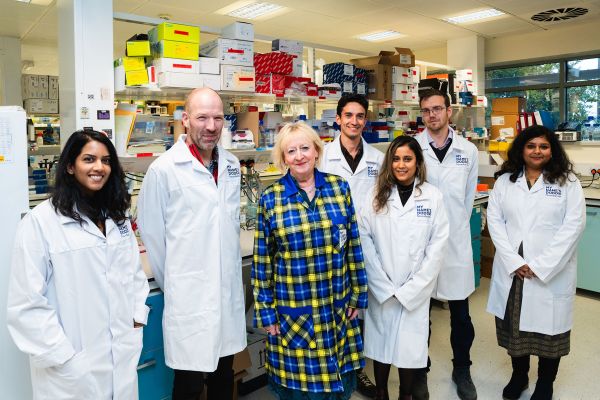
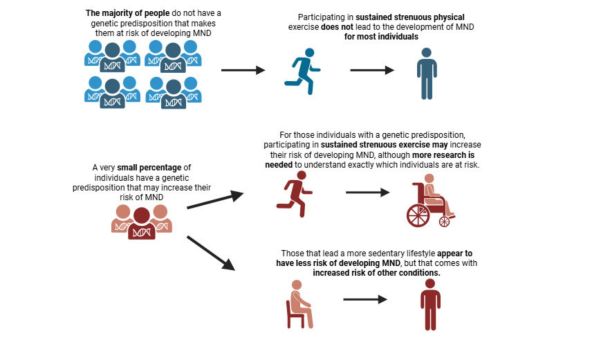
Diagram: The interplay between genetics and strenuous exercise and risk of MND.

This research highlights the complex way in which genetics and environmental factors could interact in the development of MND. It opens up important avenues of investigation into intense physical exercise and MND. It is important to make clear that most people who participate in strenuous physical exercise and most athletes will never go on to develop MND as taking part in exercise alone is not enough to increase the risk of developing the disease.

Models of MND help us understand the development of the disease

Reliable models of MND are crucial for increasing our understanding of the disease and aiding in the development of new treatments. Alongside studying human tissue samples from the UK Biobank, the team at SITraN are using fruit flies that have been engineered to carry a known genetic risk factor for MND, to investigate how they respond to strenuous exercise. For flies without the genetic risk factor for MND, exercise was found to be beneficial and extended lifespan, as it does in humans. However, in the flies who had the genetic risk factor for MND, exercise made them weaker and increased loss of motor neurons. This is something Professor Shaw’s team have seen before in human studies.

The next step for the team is to dive deeper into what could be happening in some people’s genetic make-up that puts them at higher risk of developing MND, when they have a lifestyle involving strenuous physical activity. If we can understand more about their underlying biology and identify those at risk as early as possible, there could be an opportunity to develop personalised strategies for prevention and treatment.

Professor Shaw is a founding member of the UK MND Research Institute, which is part-funded by My Name'5 Doddie Foundation alongside the MND Association, LifeArc, MND Scotland, the NIHR and Medical Research Council. The UK MNDRI is a national network of MND centres working together to understand how and why MND happens, what might work as a treatment, and testing possible treatments in clinical trials. Through the Institute, there will be increased opportunities to test this in a wide range of model systems including cells taken from people who have MND and grown in the lab.

There is nothing in our findings to suggest that normal levels of exercise are in any way harmful. In fact, in relation to several other neurodegenerative diseases such as Alzheimer’s and Parkinson's disease, there is a lot of evidence to show exercise is a good thing for us in preventing these conditions.

Professor Dame Pamela Shaw

"The impact of this work is further unravelling what it is about the genetic makeup of a person that puts them at risk of MND if they are a strenuous athlete. This is quite difficult to unravel and requires much more research but we have good ideas on how we can take this forward. We feel sophisticated modelling in the lab will help us to understand more about this link," Professor Shaw explained.

Dr Madina Kara, interim Director of Research at the Foundation said: “We are pleased to have supported this important research. These findings mark an important step in our increased understanding of some of the underlying causes of MND. They demonstrate the need for continued research to unravel the underlying genetic and environmental risk factors, so we can develop targeted prevention and treatment strategies. We will continue to invest in critical research in line with our research strategy.”

It is crucial to highlight that while this study identified a risk factor for MND in a small number of people, there is no need for alarm. Research is ongoing into links between strenuous exercise and MND, and there is still no clear answer. However, we do know that exercise is an essential part of a healthy lifestyle, preventing many health conditions such as cardiovascular disease, dementia and stroke, as well as improving mental and social wellbeing as outlined by the NHS. Therefore, it is important to emphasise that the benefits of exercising vastly outweigh any potential risk.

Check out an article by Professor Dame Shaw and Dr Cooper-Knock on their findings.

We would like to thank The Netherby Trust and supporters of the Foundation whose generous donations allow us to fund this important work. Finally, we’re grateful to all those affected by MND who support our researchers by donating tissue samples that are essential to this research.

More news & stories

View all
 picture
Research
23 Sep 2026

Topline announcement of Phase 3 trial results for FUS-MND appear promising

Yesterday, the companies Otsuka and Ionis announced the results of their Phase 3 trial of the genetic therapy, ulefnersen. Ulefnersen targets a rare form of MND…
Read more
 picture
MND stories Research
14 Sep 2026

R.A.C.E. to Diagnose: New training programme to speed up MND diagnosis

For Andy Vaughton, receiving a motor neuron disease (MND) diagnosis in 2021 finally provided an answer for symptoms he had been struggling with for several years.…
Read more
 picture
Fundraising MND stories
10 Sep 2026

"I love you, and this is for you": Cammy cycles over 1,000 miles in memory of his Dad

This year, Cammy Jones has taken on two long-distance cycling challenges for My Name’5 Doddie Foundation: Doddie’s Triple Crown, which saw him ride from Melrose…
Read more
Bell icon

Join our Newsletter!

By subscribing, you confirm that you agree with our terms and conditions.