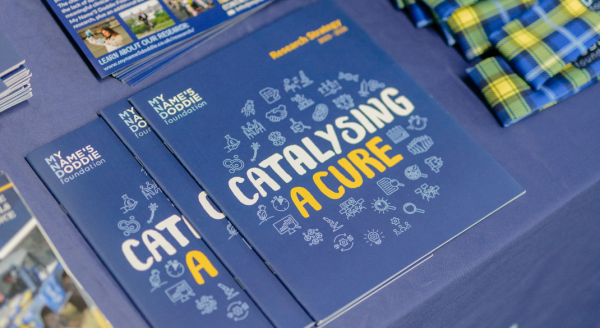
In our five-year research strategy, Catalysing a Cure, we said we would invest in research to identify new targets for future treatments, to validate those targets robustly and to develop and test potential new treatments for MND in the lab. This year we have spent £2 million on exactly this kind of research, through our Advancing Treatments and Catalyst Awards. Nine new projects across the UK have received funding, which all aim to accelerate the search for effective treatments.
Target identification
Our researchers will be exploring exciting new areas of MND biology and using cutting-edge techniques to better understand what goes wrong in motor neurons. We have one project exploring the newly implicated “inflammasome” pathway to identify new treatment avenues, and another that will map motor neuron synapses in minute detail using a highly sophisticated technique called “spatial multi-omics”. There’s even a project that will create “mini brains” – 3D lab-grown models – and use a brand-new sequencing technology to measure genetic transcript changes in individual cells to search for potential treatment targets.
These projects are so important as they combine novel thinking with the latest technologies to help identify completely new treatment approaches.
Target validation
We’ve funded projects that will further investigate previously identified targets to confirm whether they should be the focus of future drug development efforts. For example, one project is exploring a pathway that is involved in appetite and weight gain but has also been shown to have relevance to MND. Another project is looking at “excitotoxicity”, a process that causes injury to motor neurons due to excessive stimulation by glutamate.
Conducting these thorough validation studies to rigorous standards means that new approaches can be prioritised, additional funding can be unlocked and industrial partners can be engaged early to accelerate progress.
Development of potential treatments
Finally, we’re kickstarting several projects that are working to develop and test new potential treatment approaches in the lab. This includes two gene therapy approaches; one targeting FUS-MND, which accounts for a small subset of the MND population, and another highly novel approach to target TDP-43, which is dysregulated in 97% of cases of MND. We’re also looking at more traditional small molecule drugs to target “paraspeckles” - special granules that help cells survive and are thought to protect motor neurons in MND.
The failure rate in drug development is high, so we are investing in multiple different approaches to help find a winner.
Going further, faster