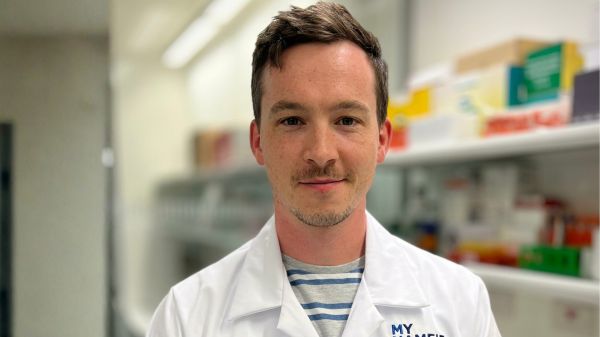
This year we are funding three researchers conducting bold exploratory research into MND through our Catalyst Awards. Dr Hamish Crerar of the Francis Crick Institute will use our funding to better understand the role of a protein called Tau, which is heavily involved in Alzheimer’s disease, as a potential treatment target for MND.
Tau in the brain
Tau plays a crucial role in the healthy brain. It stabilizes tiny structures called microtubules that help our nerve cells keep their shape and organization. In Alzheimer’s disease, tau goes haywire. It clumps into tangles which become toxic and damage cells.
Dr Crerar’s project centers around two proteins that control Tau’s delicate balance. These are called – deep breath here – fused in sarcoma (FUS) and splicing factor proline and glutamine-rich (SPFQ). When levels of these two proteins go down, or if they are moved from their correct location in the cell, tau shifts out of balance, raising its chances of forming harmful clumps.
Previous research from Professor Rickie Patani’s lab has shown that FUS and SPFQ are consistently found in the wrong place in MND. Dr Crerar believes that the loss of these proteins is driving the formation of toxic tau and causing harm to motor neurons. He will first demonstrate that this is happening in MND and then importantly, he will test the theory that motor neurons have a better chance of survival if tau is removed.
What will the research involve?
Dr Crerar will make neurons from stem cells taken from people living with MND and compare them with those made from healthy volunteers – see our handy infographic on iPSCs to find out more about how these cells are made. This “disease in a dish” approach allows him to study any changes that exist between MND neurons and healthy neurons. He will investigate all aspects of tau regulation, from the moment the cell decides to create this protein right up until its final function. He will manipulate the changes in FUS and SPFQ that occur in MND so they return to normal and study whether this improves the cell’s chances of survival, and therefore whether this approach would likely improve the symptoms of those living with MND.
If this approach is successful, he will then generate gene therapies known as ASOs (antisense oligonucleotides) that will target the toxic tau molecules, returning them to healthy levels. If these gene therapies improve the cell’s survival chances, it will strongly indicate that it is worth targeting tau for future MND treatments.
The potential impact of this research
Dr Crerar and his team hope that by investigating these delicate balances in the cell that have the potential to be affected in all cases of MND, they can position tau an attractive target for new treatments. Because of the role of tau in Alzheimer’s disease, there are many treatments already in development that could therefore also be tested in MND.