Further £5 million investment in the UK MND Research Institute
Friday, 13 November 2026
Research
We are supporting the next phase of the UK Motor Neuron Disease Research Institute (UK MND RI), as part of a new £5 million co-funded commitment alongside the MND Association and the medical research organisation LifeArc over the next five years.
The UK MND RI is a national network of leading MND research centres working together to understand how and why MND develops, identify promising therapies and support clinical trials. The institute is co-directed by Professor Ammar Al-Chalabi and Professor Christopher McDermott, with support from a leadership team that includes people living with MND.
The £5 million committed to the institute will help drive forward UK-wide efforts to better understand MND, develop potential new treatments and strengthen collaboration across the MND research community.
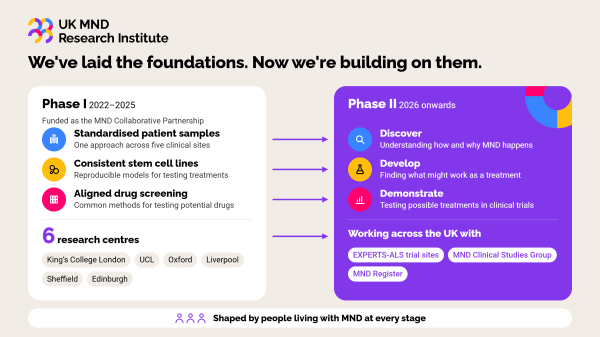
Phase 1 of the UK MND RI, then known as the MND Collaborative Partnership, brought together six leading UK research centres - King's College London, University College London, and the Universities of Oxford, Liverpool, Sheffield and Edinburgh - helping create a more coordinated approach to MND research across the UK.
Key successes of Phase 1 include coordination of national sample collection efforts, screening of over 550 potential drugs, development of a new collection of lab cell models of MND, and making it easier for people living with MND to take part in research.
Building on the that progress, the UK MND RI will expand in Phase 2 to include additional institutions across the UK, strengthening national coverage through the inclusion of major EXPERTS-ALS trial sites
The UK MND RI was established following the United2EndMND campaign in 2021, which was driven by people affected by MND. The campaign called on the UK Government to commit £50 million of new investment to accelerate the search for new treatments for MND.
Since launching in 2023, the institute has helped bring researchers and clinicians together in a way not previously seen in MND research, streamlining collaboration and developing new tools and infrastructure to support scientific progress.
Over the next five years, this £5 million investment will support the UK MND RI to continue its work to deepen the understanding of MND biology, support the development and testing of new treatments, expand biosampling programmes and strengthen connections across the UK MND community.
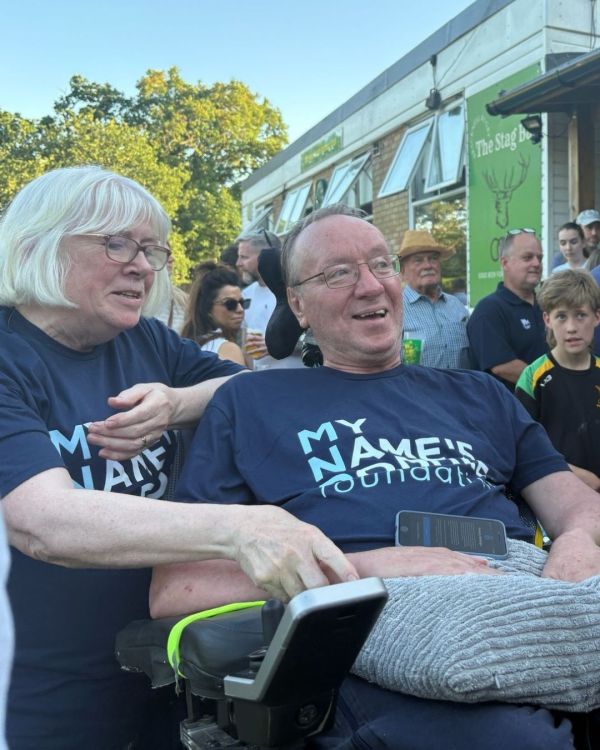
The announcement of this sustained funding into the UK MND RI has been welcomed by campaigners, including David Setters, who was diagnosed with MND in 2012. David is a member of the institute’s executive group, and played a key role in the United2EndMND campaign.
He said: "This £5 million is fantastic news – it gives our scientists the bedrock funding they need to keep moving forward in search of effective treatment and one day a cure for MND. Before our campaign in 2021, we had brilliant scientists working across the UK, but no coordinated strategic plan bringing their work together."
We have made real progress since then and now we need to build on it and move faster. This funding – and the work it will enable the UK MND RI to do – can be a massive catalyst towards that. There is more hope now than there has ever been.
“I was diagnosed in 2012 and feel very fortunate to have lived for 14 years with MND – most people do not have that time. It is incredibly difficult to see people you have got to know die from the disease, and that is what drives us to keep pushing for more."
Our Director of Research, Jessica Lee, said: “Collaboration remains central to accelerating progress in MND research, and we are proud to continue supporting efforts that bring together researchers, clinicians and people affected by MND with the shared goal of finding effective treatments and, ultimately, a cure.”
Professor Ammar Al-Chalabi, co-director of the UK MND RI, said: “When people living with MND campaigned for this institute, they asked for something simple: that researchers across the country unite to research MND at the pace the disease demands. Our first funding phase showed it can be done. We now have one national way of collecting samples, standardised lab models so a finding in one lab can be checked in another, and new ways for people to take part in research from home."
The other co-director of the UK MND RI, Professor Chris McDermott, added: “The Phase 2 funding lets us put those foundations to work, and in this next phase, we hope to build on the infrastructure and achievements we’ve already made. This means more people living with MND, wherever they live, can take part in research, and the most promising ideas can move toward testing in people as quickly and safely as possible. We are hugely grateful to My Name’5 Doddie Foundation, the MND Association and LifeArc for their continued support.”
Alessandra Gaeta, Senior Director at LifeArc, said: “MND research is at a pivotal point, with stronger collaboration, better shared infrastructure and a growing pipeline of potential approaches to treatment. We are delighted to continue to support the next phase of the UK MND Research Institute, with My Name'5 Doddie Foundation and the MND Association, to help to bring together the expertise, tools and partnerships needed to turn scientific progress into real benefits for people affected by MND.”
Dr Mike Rogers, Director of Research and Innovation at the MND Association, said: “During the next five years, more than 10,000 people will be diagnosed with MND in the UK. We need strong collaboration and the most innovative thinking to drive progress for every family that's affected.
“That’s why it’s so vital that the institute is joining the dots between the brightest minds at leading centres of MND research, increasing the pace of discovery towards treatments and a cure. We’re delighted to support the next phase of the UK MND Research Institute and look forward to seeing what it can produce.”
To find out more about the UK MND RI, visit ukmndri.org